Customer data has never been more abundant — or more fragmented. Marketing, sales, customer success, and data teams all rely on different systems to capture interactions, behaviors, and transactions, but those systems rarely connect.

Fragmented customer data causes incomplete or inconsistent customer profiles. This issue is widespread: up to struggle to unify customer data across systems. Incomplete customer profiles limit personalization beyond basic segments, making it difficult for organizations to deliver the personalized experiences that drive engagement and long-term growth.
This challenge directly impacts revenue outcomes, including , retention, and expansion. When customer insights sit across CRMs, support tools, product analytics, and marketing platforms, teams struggle to align on a single source of truth.
Customer intelligence platforms (CIPs) can help teams manage this complexity. combines data, context, and analysis to guide customer decisions. CIPs unify this data, resolve identities, and generate insights that teams can activate across marketing, sales, and customer service. Read on to discover top CIPs, such as HubSpot, that teams can adopt to break down silos, accelerate time-to-value, and build a more complete, actionable understanding of the customer journey.
Table of Contents
What is a customer intelligence platform?
A customer intelligence platform (CIP) is software that unifies customer data from multiple systems, resolves identities across sources, and generates insights that marketing, sales, and customer service teams can use to guide customer decisions. A CIP performs four core functions:
- A customer intelligence platform unifies customer data from multiple systems. Data from CRMs, support platforms, marketing automation tools, product analytics tools, and billing systems combine into a single profile.
- A customer intelligence platform performs identity resolution to match records to people and accounts. It connects emails, device IDs, , transactions, and interactions into a single, continuously updated view of each customer and company.
- A customer intelligence platform generates customer intelligence insights to support decision-making and actions. Using analytics and AI, CIPs surface patterns such as lifecycle-stage changes, expansion opportunities, churn risk, and product adoption trends.
- A customer intelligence platform supports activation by syncing insights to customer-facing tools, enabling marketing, sales, and customer service teams to trigger campaigns, prioritize accounts, personalize outreach, and improve customer experiences.
Ultimately, a CIP serves as the intelligence layer, transforming scattered customer data into coordinated, data-driven actions across the entire revenue organization. That’s critical, as the majority of organizations still operate with disconnected data environments. Research indicates that over keep valuable insights in places like spreadsheets or messages rather than their CRM, making unified intelligence platforms increasingly essential.
A CIP helps businesses deliver more personalized, unified customer experiences. HubSpot supports this work by collecting and unifying customer data in HubSpot Smart CRM and helping teams activate insights across connected products like Marketing Hub, Sales Hub, Service Hub, and Data Hub.
Customer intelligence platform vs. CRM vs. CDP vs. BI
Customer intelligence platforms, CRMs, CDPs, and BI tools can overlap, but each system plays a different role in the customer data stack.
Three important distinctions to highlight:
- CRM serves as the system of record for customer interactions and pipelines.
- CDP focuses on collecting and organizing customer data for activation.
- BI tools focus on reporting and analysis of what happened.
Pro tip: I wouldn’t evaluate a customer intelligence platform as a one-to-one replacement for a CRM. The stronger question is whether the platform can turn existing CRM, support, marketing, product, and billing data into insights that customer-facing teams can actually use. In my experience, the best CIP setup does not create another isolated system. It strengthens the systems teams already use by giving them cleaner data, clearer signals, and faster ways to act.
To understand more, check out HubSpot’s guide on .
Best Customer Intelligence Platform Tools
1. HubSpot ( + + )
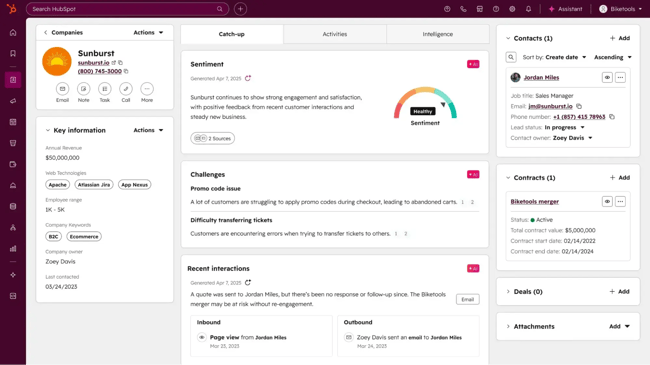
HubSpot has evolved into a full customer intelligence platform by combining its core systems into a single, connected architecture. It joins:
- . HubSpot CRM is the AI-powered system of record for contacts, companies, deals, and service interactions.
- . Data Hub unifies and cleans customer data across systems, improving identity resolution and data quality so teams have a reliable view of each customer.
- . HubSpot’s AI analyzes activity and engagement signals to generate predictive insights and automate workflows.
- Activation tools across , , and .
Together, these HubSpot products create a shared intelligence layer that unifies customer data, generates insights, and helps teams act on those insights without stitching together multiple disconnected tools.
HubSpot Smart CRM sits at the core of the HubSpot ecosystem, connecting products through shared customer data. It goes beyond storing records by unifying structured data (contacts, deals) with unstructured interactions (emails, calls, chats) and external signals into a single, complete customer view. That allows teams to identify key insights, make better decisions, and maintain accurate data through automated enrichment and duplicate detection.
Teams can activate customer intelligence across HubSpot products — especially Service Hub, which turns support, feedback, and customer health data into retention and growth signals. It centralizes support conversations, manages tickets, tracks performance, and enables proactive customer success through health scoring and renewal tracking. With Breeze supporting automation and AI agents, teams can respond faster and continuously feed new insights back into HubSpot Smart CRM.
Built-in AI further enhances this intelligence by analyzing engagement signals to deliver predictive lead scoring, conversation insights, and personalized recommendations. Teams can prioritize accounts, uncover buying signals, and trigger automated workflows based on real-time customer behavior.
Key Features
- Unified customer profiles. HubSpot Smart CRM centralizes contacts, companies, deals, and service interactions to create a single, shared view of each customer.
- Data unification and quality. Data Hub connects and cleans customer data across systems, helping teams maintain accurate, reliable records.
- AI-powered insights. Breeze analyzes engagement and behavioral signals to surface predictive insights and automate actions.
- Customer service and success intelligence. HubSpot Service Hub captures support, feedback, and customer health signals to help teams resolve issues, monitor retention, and prioritize outreach.
- Cross-team activation. Teams can use insights across HubSpot Marketing Hub, Sales Hub, and Service Hub to power campaigns, prioritize accounts, and streamline service workflows.
Best for: Companies that want a unified platform for customer intelligence, operations, and activation.
Pricing: HubSpot Smart CRM starts at $50 per seat/month.
What we like: HubSpot unifies data, analytics, and customer engagement in a single ecosystem, reducing the complexity of assembling a CIP across multiple vendors and delivering a better, more cohesive customer experience.
Pros
- Unified platform for customer data and activation.
- Strong AI automation capabilities.
- Integrated service analytics and feedback tools.
Cons
- Advanced enterprise integrations may require implementation support.
2.
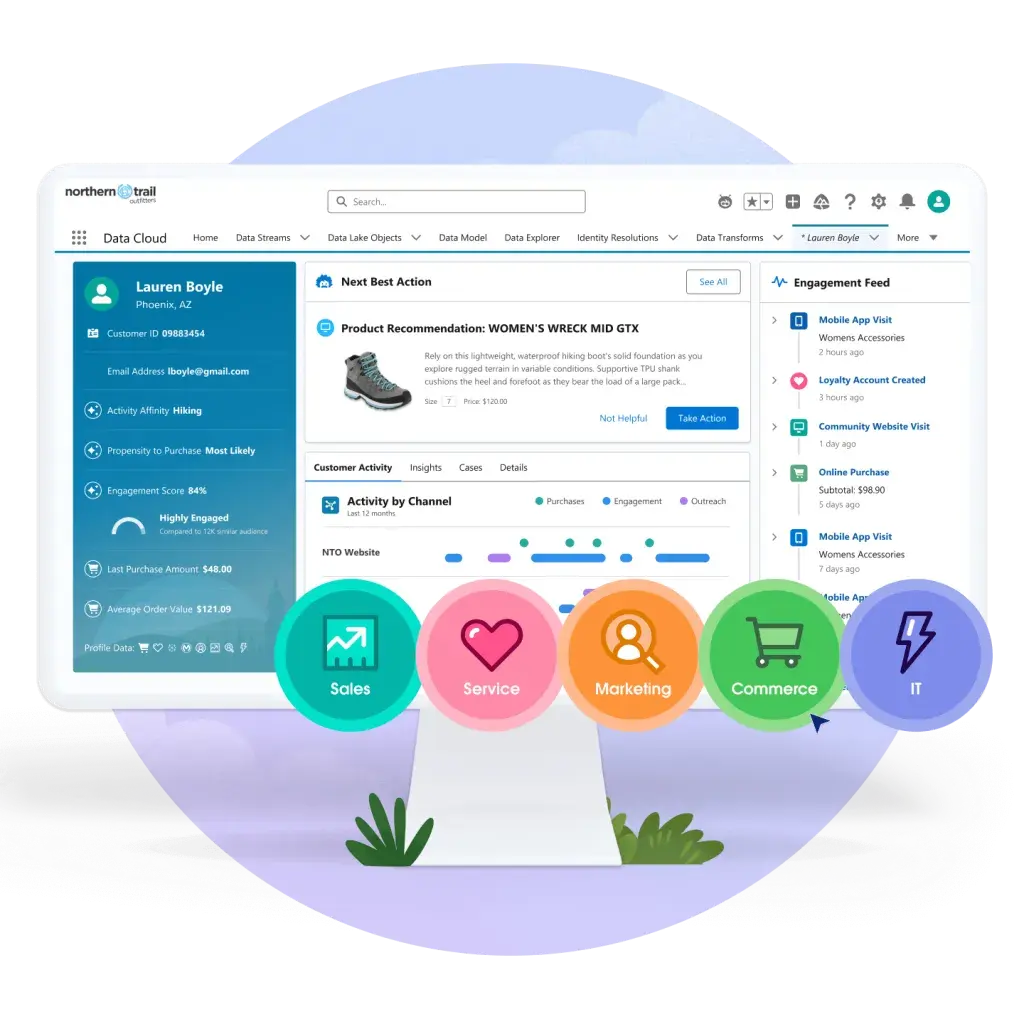
is a customer intelligence platform that unifies data across sales, service, marketing, and commerce to create a single, shared view of each customer. Built on Salesforce’s ecosystem, it connects multiple clouds and data sources, enabling teams to access consistent, real-time across touchpoints. With embedded AI and automation, organizations can deliver personalized experiences and make data-driven decisions at scale.
Key Features
- Unified customer profiles bring together data from across Salesforce products and external systems to create a single, accurate profile for each customer.
- AI-powered insights (Einstein) generate predictions, recommendations, and next-best actions across the customer lifecycle.
- Cross-cloud integration seamlessly connects Salesforce sales, service, marketing, and commerce tools.
- Real-time data activation enables teams to segment audiences and trigger personalized experiences based on live customer data.
Best for: Mid-to-large enterprises that need a highly customizable, end-to-end customer intelligence platform spanning sales, marketing, service, and commerce.
Pricing: Salesforce pricing varies by product and edition. For customer data use cases, Data 360 lists Flex Credits at $500 per 100k credits, Profiles at $240 per 1k profiles/year, and Enterprise Profiles at $420 per 1k profiles/year. Salesforce recommends contacting sales for detailed pricing.
What we like: Salesforce provides enterprise teams with a broad ecosystem for connecting customer data, CRM workflows, service operations, marketing, commerce, and AI-powered automation.
Pros
- Highly customizable and flexible platform tailored to complex business processes and workflows.
- Powerful ecosystem with extensive integrations, apps, and scalability.
- Strong AI and automation capabilities.
Cons
- Steep learning curve and implementation complexity.
- High total cost of ownership, especially when adding multiple clouds and advanced features.
3.
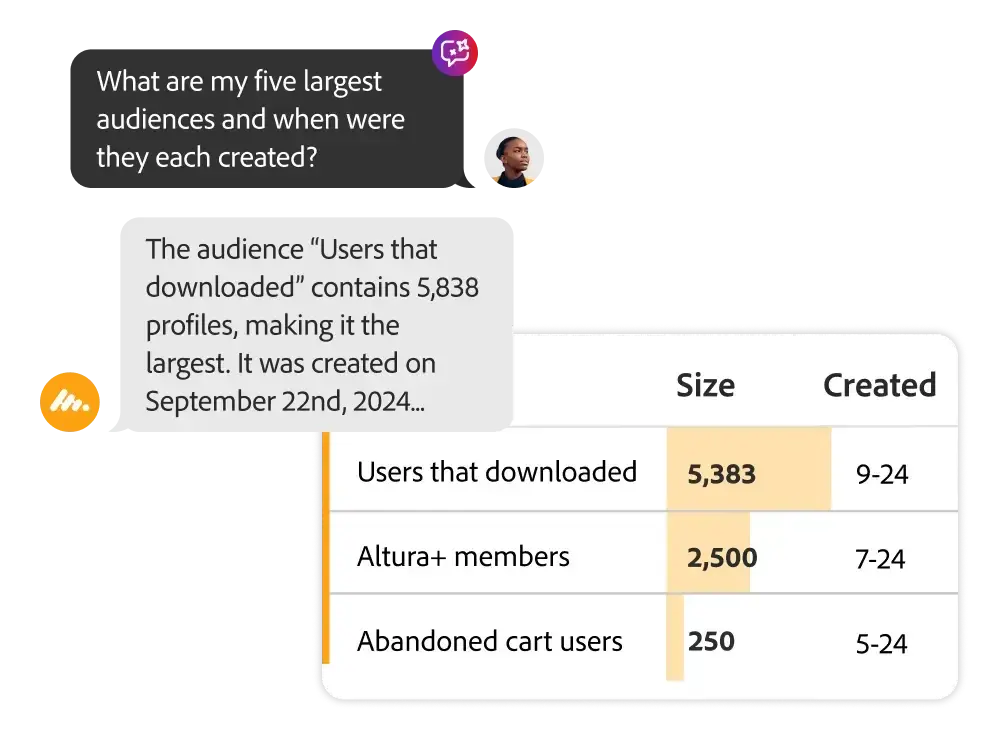
is an enterprise customer intelligence platform that unifies customer data, resolves identities in real time, and powers personalized experiences across channels. It combines data ingestion, profile unification, AI-driven insights, and activation into a single system built for large-scale customer experience management.
Key Features
- Real-time customer profiles combine behavioral, transactional, and demographic data into a unified, continuously updated view of the customer.
- Advanced identity resolution. Links data across devices, channels, and systems to create accurate profiles.
- AI-powered insights (Adobe Sensei) generate predictive audiences, recommendations, and next-best actions.
- Omnichannel activation delivers personalized experiences across web, mobile, email, and advertising channels.
- Composable, API-first architecture enables deep customization and integration with enterprise systems and third-party tools.
Best for: Enterprise B2C and marketing-led organizations that need real-time personalization and advanced customer journey orchestration at scale.
Pricing: Adobe Experience Cloud pricing is package-based and varies by product, data volume, and use case. Adobe lists products such as Real-Time CDP, Journey Optimizer, Customer Journey Analytics, and Marketo Engage on its pricing page.
What we like: Adobe Experience Platform stands out for its ability to connect data, AI, and activation into a real-time system that powers deeply personalized customer experiences at enterprise scale.
Pros
- Strong real-time personalization and journey orchestration.
- Highly scalable platform for large, complex data environments.
- Strong integration with Adobe’s broader ecosystem.
Cons
- High cost and implementation complexity.
- Steeper learning curve than more out-of-the-box platforms.
4.
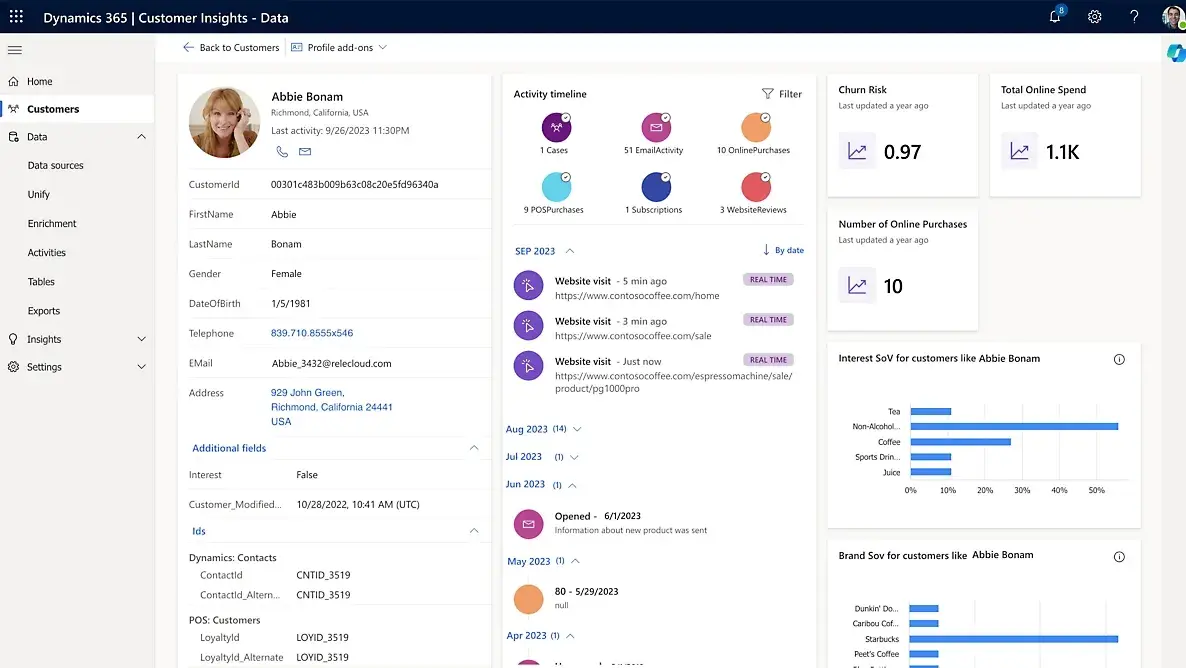
is a customer intelligence platform that unifies data from multiple sources to create a complete, real-time view of each customer. It combines CDP capabilities with AI-driven insights, segmentation, and activation to support personalized engagement across the customer lifecycle.
Key Features
- Unified customer profiles combine data from multiple sources into a single, comprehensive customer view.
- AI-driven insights and predictions identify trends, behaviors, and opportunities for engagement.
- Segmentation and audience building create dynamic customer segments for targeting and personalized marketing.
- Real-time data processing continuously updates profiles and insights based on live customer activity.
- Integrates with the Microsoft ecosystem — Dynamics 365, Azure, Power BI, and other Microsoft tools.
Best for: Organizations that want to unify customer data and generate actionable insights within the Microsoft ecosystem (Azure, Dynamics, Power Platform).
Pricing: Dynamics 365 Customer Insights starts at $1,700 tenant/month, paid yearly. Customer Insights Attach starts at $1,000 tenant/month, paid yearly for organizations with a qualifying Dynamics 365 application. Additional Unified People and Interacted People capacity packs are priced separately.
What we like: Microsoft Customer Insights combines data unification, segmentation, analytics, and activation in a way that fits naturally for organizations already using Dynamics 365, Azure, Power BI, or other Microsoft tools.
Pros
- Strong data unification and analytics capabilities.
- Deep integration with the Microsoft ecosystem and tools.
- Flexible platform for both B2B and B2C use cases.
Cons
- Implementation and setup can be complex.
- Requires technical expertise to fully realize value.
5.
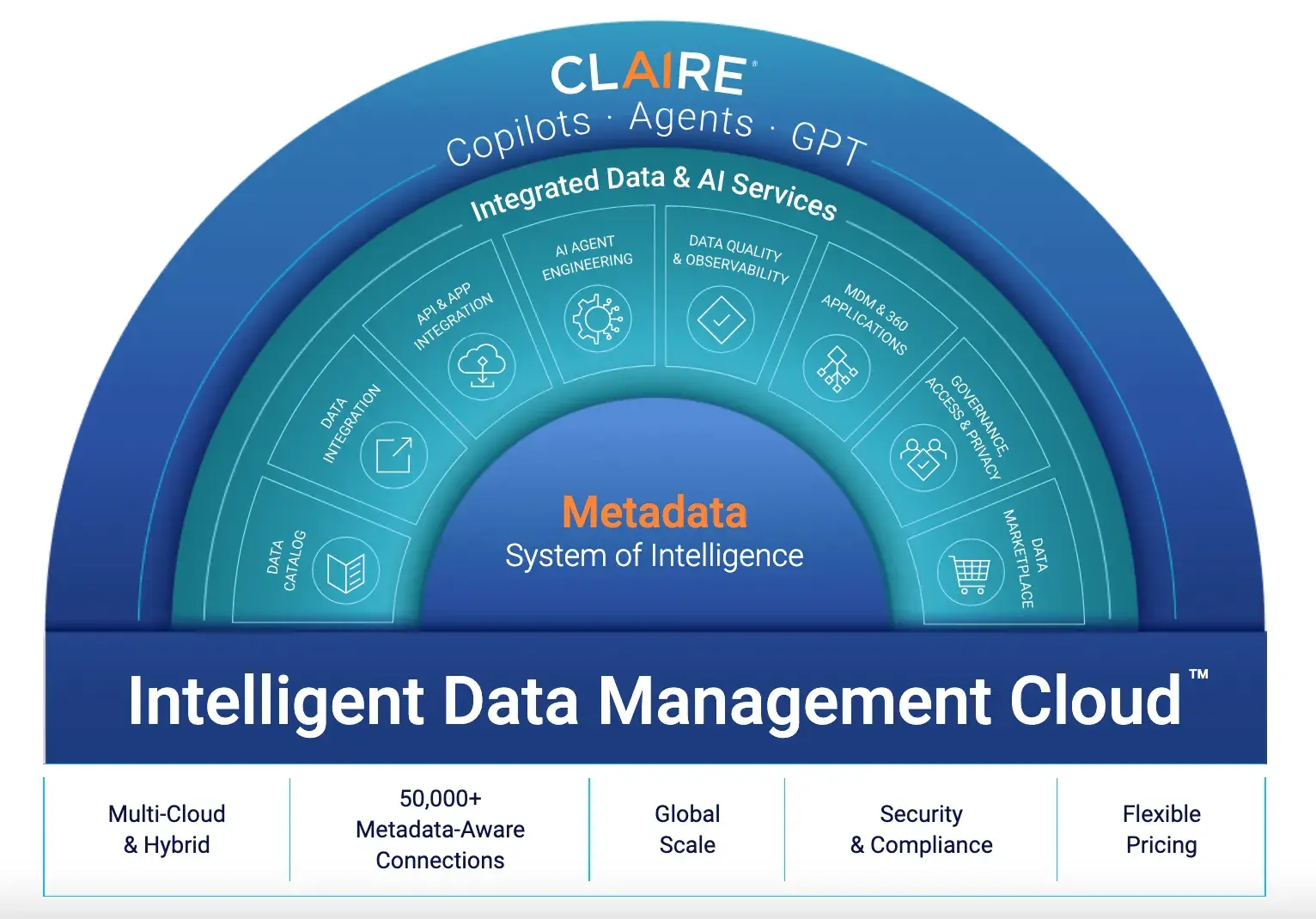
is an enterprise-grade customer intelligence and data management platform designed to unify, govern, and activate data across complex systems. Its Intelligent Data Management Cloud brings together data integration, quality, governance, and master data management to create a single, trusted view of the customer. Leveraging AI-powered automation helps organizations turn fragmented data into actionable insights that improve customer experiences and business outcomes.
Key Features
- AI-powered data management uses an AI engine to automate data integration, quality, and governance processes across systems.
- Customer 360 view unifies customer data from multiple sources to create a single, accurate profile for personalization and analytics.
- Data integration and ETL connect, transform, and pipeline data across cloud and on-premises environments for consistent access.
- Data governance and quality ensure data accuracy, compliance, and reliability with built-in governance tools.
Best for: Large enterprises with complex data ecosystems that need advanced data integration, governance, and a unified customer view for analytics and personalization.
Pricing: Informatica uses consumption-based pricing and asks buyers to request a quote.
What we like: Informatica brings data integration, governance, quality, and master data management into a single platform, making it a strong fit for enterprises that need trusted customer data at scale.
Pros
- Comprehensive data platform covering integration, governance, quality, and master data management.
- Highly scalable and flexible architecture that supports complex enterprise data.
- Strong automation and AI capabilities.
Cons
- Enterprise implementations can require significant technical resources, especially for organizations with complex hybrid or multi-cloud data environments.
- Higher cost and resource investment compared to simpler customer intelligence tools.
6.
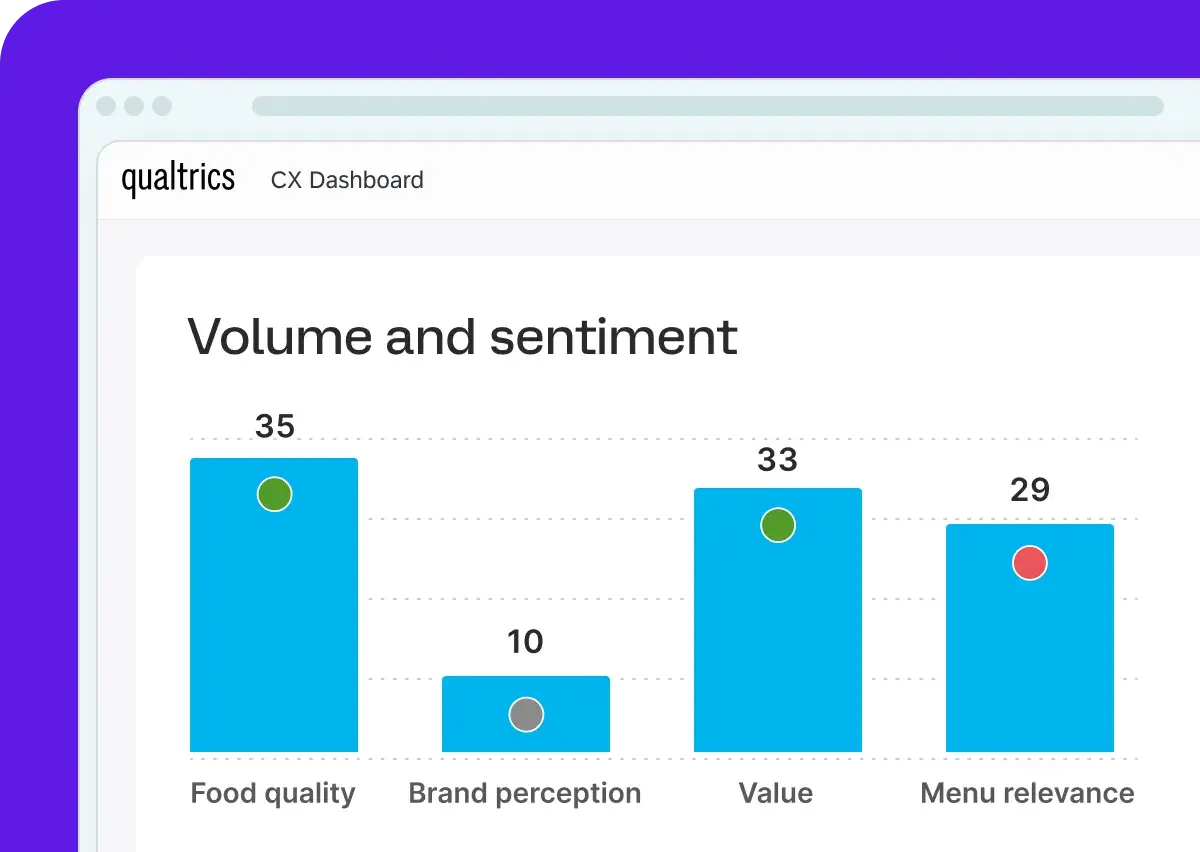
XM is a customer experience management platform that analyzes customer feedback and sentiment across touchpoints, enabling companies to gain a holistic view of their customers. It integrates data from calls, chats, surveys, and digital experiences to identify friction in the customer experience. Customer support teams can then proactively resolve issues, prevent churn, and deliver the best possible experience to customers.
Key Features
- The Voice of Customer (VoC) tool unifies structured data from customer surveys with unstructured data from calls, chat, SMS, email, and social media into a single, clear view of customer sentiment.
- Omnichannel experience management. AI takes customer experience data from a business’s app, website, calls, social media, and in-store to reveal patterns and create comprehensive customer profiles.
- Online reputation management allows teams to monitor and respond to reviews across 20+ sites and use AI to generate personalized responses.
- Interactive dashboards provide real-time, customizable visualizations that allow teams to explore customer experience data, uncover trends, and quickly act on insights across the organization.
Best for: Mid-to-large enterprises focused on improving customer experience at scale through data-driven insights and omnichannel feedback management.
Pricing: Qualtrics uses quote-based pricing for XM programs. Its pricing model uses interactions, such as survey responses, calls, chats, emails, social reviews, and other data records processed by Qualtrics.
What we like: Qualtrics brings feedback from multiple channels into one platform, making it useful for teams that need to connect survey data, service interactions, reviews, and digital experience signals.
Pros
- Advanced analytics and reporting with actionable insights.
- Robust survey design with advanced logic, targeting, and segmentation.
- Highly flexible and scalable platform with strong integration capabilities.
Cons
- Steep learning curve for new users.
- High price point.
7.
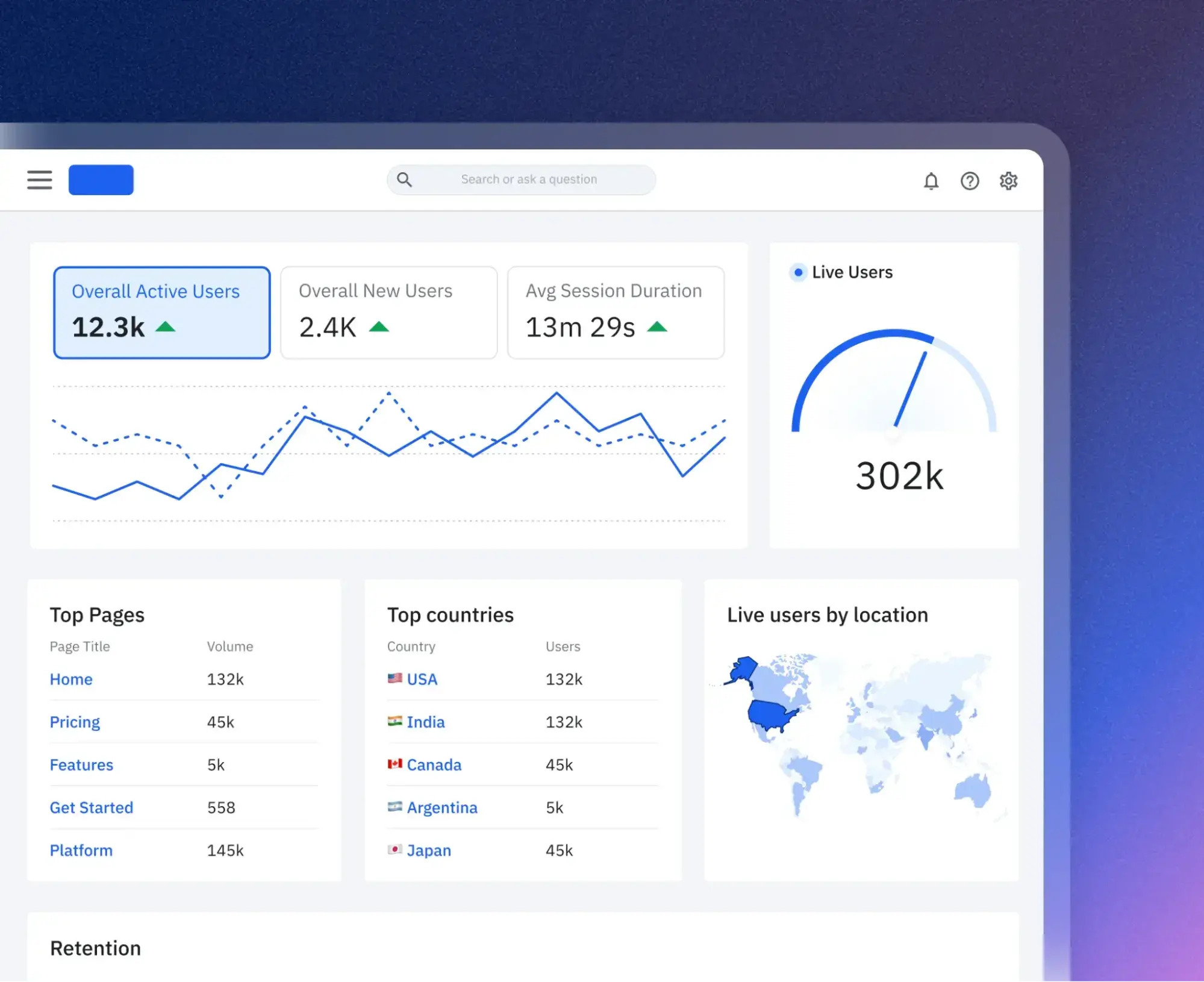
is a behavioral analytics platform focused on product usage insights and customer journeys. It helps teams understand how users interact with digital products by tracking behaviors, events, and conversion paths in real time. With a strong focus on experimentation and optimization, Amplitude enables companies to continuously improve product experiences based on data.
Key Features
- AI Agents perform deep research, generate charts and dashboards, govern data at scale, and explain the why behind the numbers.
- Session playbacks allow product teams to see exactly how customers use their digital product and where they might experience friction.
- AI Feedback analyzes customer reviews, surveys, and support tickets to reveal what customers are saying, surface insights, and suggest next steps.
- Advanced segmentation and cohort analysis help teams group users by behaviors, attributes, or lifecycle stages to better understand retention, engagement, and conversion trends.
Best for: Product-led companies and digital teams looking to optimize user journeys and drive growth through detailed behavioral analytics.
Pricing: Amplitude offers a free Starter plan. Paid plans start at $49/month with Plus.
What we like: Amplitude connects user behavior to product decisions, making it easier for teams to identify what works, where users drop off, and which journeys need improvement.
Pros
- Amplitude offers pre-made templates based on use cases to help teams get started quickly with dashboards and analytics.
- Powerful behavioral analytics capabilities provide deep visibility into user journeys and product performance.
- Strong data visualization tools that make it easier for cross-functional teams to interpret insights and make informed decisions.
Cons
- Complex tool with a considerable learning curve to get up and running.
- Pricing can become expensive as data volume and event tracking needs grow.
8.
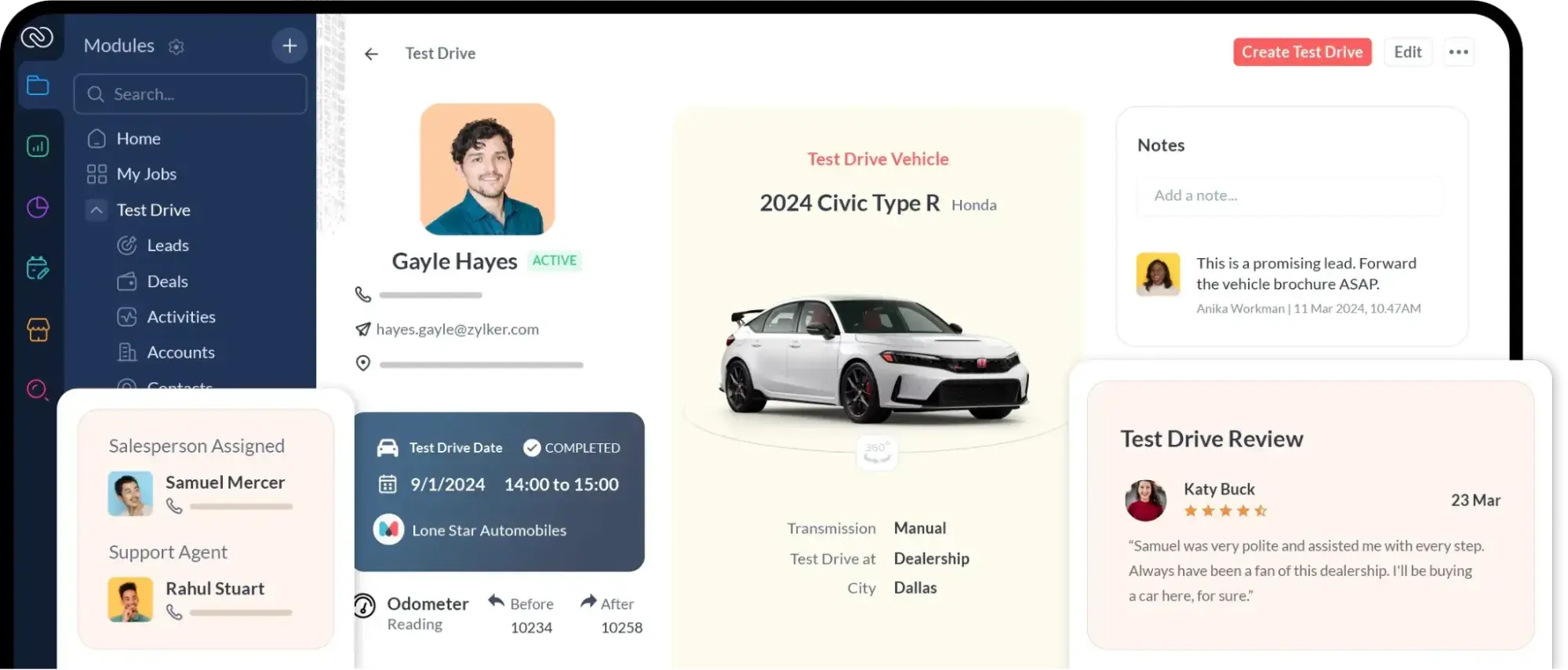
is a customer intelligence platform that unifies data from sales, marketing, and customer support to create a complete, real-time view of each customer. Zoho CRM Plus breaks down data silos across teams, enabling businesses to track customer behavior, interactions, and sentiment throughout the customer lifecycle.
Key Features
- 360-degree customer view consolidates customer data from all touchpoints — including sales, support, campaigns, and social — into a single profile.
- Omnichannel data collection captures and connects interactions across email, chat, phone, social media, and web to provide full context for every customer journey.
- AI-powered insights (Zia) analyze customer behavior, predict trends, detect sentiment, and recommend next-best actions.
- Unified analytics and dashboards combine data across departments to deliver real-time reporting, KPI tracking, and deeper customer insights.
Best for: Small to mid-sized businesses that want an affordable, all-in-one customer intelligence platform to unify data and improve customer experience across the lifecycle.
Pricing: Zoho CRM Plus starts at $57 per user/month, billed annually, with a 30-day free trial available.
What we like: Zoho turns everyday customer interactions into data that teams can use to understand and improve the customer journey.
Pros
- Strong ability to unify fragmented customer data into one actionable view.
- Built-in analytics and AI make it easy to turn customer data into insights without needing a separate BI tool.
- All-in-one platform reduces the need for multiple tools.
Cons
- It can feel overwhelming due to the breadth of features and modules.
- Some advanced analytics and AI capabilities may require higher-tier plans.
How to Choose a Customer Intelligence Platform
Selecting the best customer intelligence platform requires teams to evaluate both technical capabilities and operational fit. This checklist can guide platform comparisons.
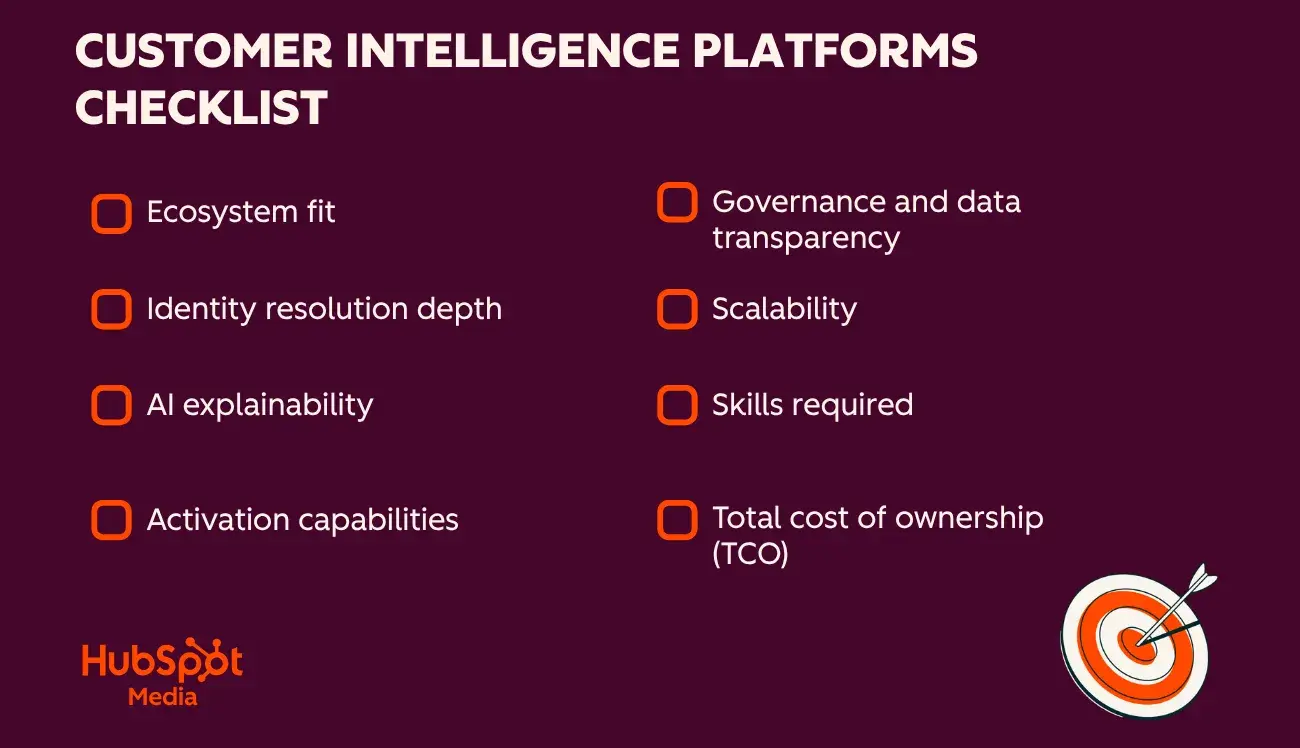
- Ecosystem fit. Teams should first consider how well the CIP fits with their existing tech stack. Is it part of the same ecosystem, like HubSpot or Microsoft, or will it need to connect to multiple third-party tools? Look for platforms with strong native integrations or flexible APIs to avoid costly custom engineering work.
- Identity resolution depth. Evaluate how effectively the platform can unify customer data across devices, channels, and touchpoints into a single profile. Strong identity resolution ensures accurate tracking of customer journeys and prevents fragmented or duplicate records.
- AI explainability. Consider whether the platform’s AI-driven insights are transparent and easy to interpret. Teams should be able to understand why a system makes recommendations or predictions, not just see the output, to build trust and make informed decisions.
- Activation capabilities. Insights are only valuable if teams can act on them. Look for platforms that enable businesses to easily segment audiences and activate data in real time across marketing, sales, and customer-engagement channels.
- Governance and data transparency. Review how well the platform supports data governance, privacy, and compliance with regulations such as GDPR and CCPA. Strong controls around data access, quality, and security are essential, especially for organizations handling sensitive customer data. Check out HubSpot’s .
- Scalability. Teams should consider not just current needs but also future growth. Platforms that offer flexible pricing tiers (SMB to enterprise) or usage-based models are better suited for scaling alongside the business.
- Skills required. Assess the level of technical expertise needed to implement and maintain the platform. Some tools require dedicated data teams or engineers, while others support business users with minimal technical backgrounds.
- Total cost of ownership (TCO). Look beyond the base subscription cost and factor in implementation, integrations, training, maintenance, and potential scaling costs. A lower upfront price does not always create a lower long-term investment.
Frequently Asked Questions About Customer Intelligence Platforms
Is a customer intelligence platform the same as a CDP?
No. A customer data platform (CDP) focuses on collecting and unifying customer data from multiple sources into a single profile. In contrast, a customer intelligence platform (CIP) builds on that foundation by analyzing the unified data to generate insights, including churn risk, expansion opportunities, and product adoption patterns.
In practice, a CIP acts as the intelligence and decision layer on top of customer data. While a CDP centralizes data, a CIP helps teams interpret it and translate insights into action across marketing, sales, and customer success.
Do I still need a CRM if I have a customer intelligence platform?
Yes. A CRM acts as the system of record for customer relationships and revenue activities, including contacts, deals, account history, and service interactions. Sales, support, and account teams rely on the CRM to manage day-to-day customer engagement.
A customer intelligence platform complements the CRM by analyzing customer behavior and signals across systems and then syncing insights — like health scores or churn predictions — back to the CRM so teams can prioritize the right accounts and actions.
How long does it take to implement a customer intelligence platform?
Implementation timelines vary by data complexity, but most organizations begin to see value within 4 to 12 weeks. Initial implementation typically involves connecting core data sources, establishing identity resolution, and defining key customer metrics or segments.
More advanced capabilities — such as predictive modeling, automated insights, and cross-team activation — often evolve over the following 3 to 6 months as teams refine data quality, workflows, and use cases.
What data sources should connect to a customer intelligence platform first?
Most organizations start by connecting the systems that represent core customer interactions and revenue signals. These typically include:
- CRM data
- Product usage or website analytics
- Marketing automation platforms
- Support or ticketing systems
- Billing or subscription data
Starting with these sources allows teams to quickly build a unified view of customer behavior, lifecycle stage, and revenue impact, enabling early insights such as product adoption trends, churn risk indicators, and high-value account engagement.
How do I measure success with a customer intelligence platform?
Success is typically measured by how effectively the platform turns customer data into actionable insights and cross-team alignment. Early indicators include faster access to customer insights, reduced , improved segmentation, and more consistent metrics across marketing, sales, and customer success.
Over time, organizations track business outcomes such as:
- Improved retention
- Higher expansion revenue
- Better campaign performance
- Faster account prioritization
- Increased product adoption
Activate teams with customer intelligence.
Customer intelligence platforms have become essential for organizations looking to turn fragmented data into a unified, actionable view of the customer. As this guide shows, the right CIP can help teams move beyond siloed systems and static reporting to deliver real-time insights, better personalization, and measurable impact on metrics like retention and customer lifetime value.
The most effective solutions combine data unification, analytics, and activation in a single system. HubSpot stands out in this category by bringing together HubSpot Smart CRM, Data Hub, Breeze, and Service Hub into one connected system that generates customer intelligence and helps teams act on it across marketing, sales, and customer service. For teams looking to simplify their stack and accelerate time-to-value, HubSpot offers a practical, scalable approach to building a true customer intelligence platform.
Organizations that do not address data fragmentation risk incomplete insights, wasted spend, and missed growth opportunities. A strong customer intelligence platform gives teams a clearer way to understand customers and act on what they learn.
