College is an exciting time for students to live on their own, make new memories, and create lasting friendships. What’s not exciting is the debt you might inherit once you graduate. In the last decade, student loan debt , with students facing outstanding student loan debt.
What if there was a way you could get paid to go to college and avoid taking out any ? Sounds too good to be true, right? Well, we have twelve tactics for you to consider that just might help you go to college for free.
Keep reading for our favorite tips or jump to a specific tactic below to learn more!
1. Submit a FAFSA
Applying for financial aid through your university or college is one of the first steps new students should take to pay for college. In order to qualify for financial aid, you must first fill out the , commonly known as the FAFSA. Your completed FAFSA determines your level of financial need based on federal income tax returns and the amount of out-of-pocket money parents and students can pay toward college expenses each year.
FAFSAs must be submitted each year in order to qualify for financial aid and you if financial circumstances change within that year. Financial aid is then awarded in the form of loans, grants, and work-study programs. Unlike grants or work-study money, you must repay loans with after graduation.
How much you could get paid: The amount of money you receive will depend on your level of financial need. You could potentially receive anywhere from $4,000 to tens of thousands of dollars in financial aid each year.
2. Apply for Grants
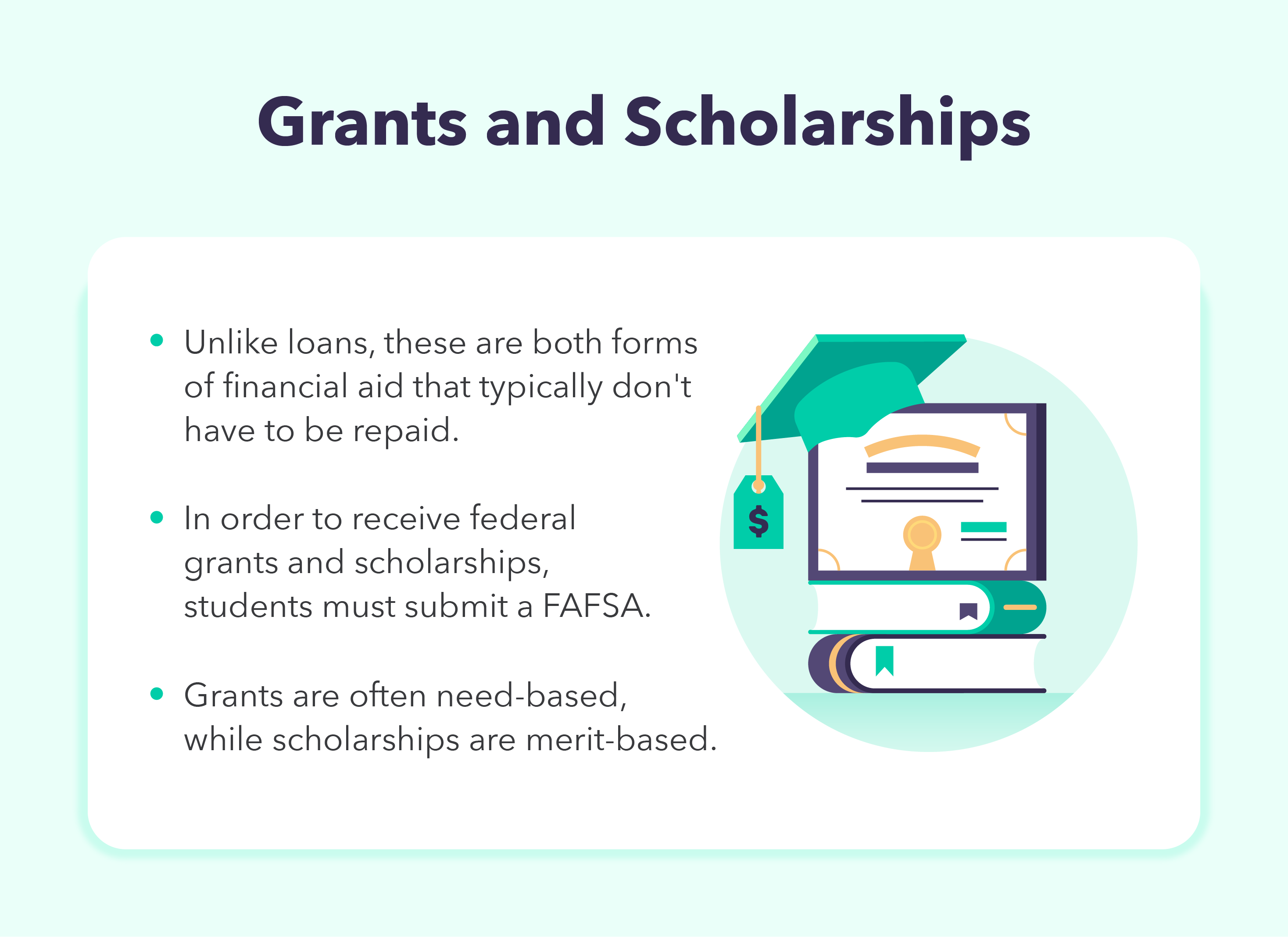
Grants are typically financial need-based, while scholarships are often merit-based. The most common federal grant students receive after submitting their FAFSA is the . The amount awarded changes each year, but during the 2022–2023 school year, full-time students received up to $6,895.
Talk to your college advisors and professors about what grants you might be eligible for. Remember that applying for can be time-consuming, but many students will give up applying after the first year or lose their scholarship altogether, leaving the door open for you to be awarded that money!
How much you could get paid: The amount of money you receive in the form of grants will depend on how many you apply for — but the most common federal grant students receive, the Pell Grant, pays up to $6,895 depending on the year.
3. Research Various Scholarships
Think of as free money you just have to apply for. Scholarships and grants are both forms of financial aid that you typically don’t have to repay and can come from organizations, individuals, federal and state governments, employers, or schools to name a few.
Merit-based scholarships take into account your academic, athletic, or special talent abilities. Diversity scholarships are awarded to minority students who qualify. There are even awarded to people based on their needs. Each scholarship will have its own application and requirements. The key to winning scholarship money is having an organized system in place with time set aside to apply. Boost your earnings by finding lesser-known scholarships with fewer applicants that you can apply for.
How much you could get paid: You can expect to receive anywhere from a few hundred dollars to several thousand dollars for each scholarship you win. The more you apply for, the better your chances will be of racking up your earnings.
4. Consider Community College
Community college is an affordable option for students with tuition and fees, costing on average compared to the you can expect to pay each year at a four-year in-state college. You could even end up attending community college for free after submitting your FAFSA and being awarded a Pell Grant. In the 2021-2022 academic year, of the federal aid received by community colleges was in the form of Pell Grants.
How much you could get paid: Each year, you have the opportunity to receive up to $6,895 from the federal Pell Grant which could cover all your costs for community college, ultimately paying you to go to college.
5. Attend Tuition-Free College
If you’re not picky about where you want to get your degree, you might consider enrolling in a community college with tuition-free education programs. Certain states started programs that offer free tuition for approved residents in the form of grant and scholarship payouts. Their goal is to give more people the opportunity to go to college by essentially paying their students to attend.
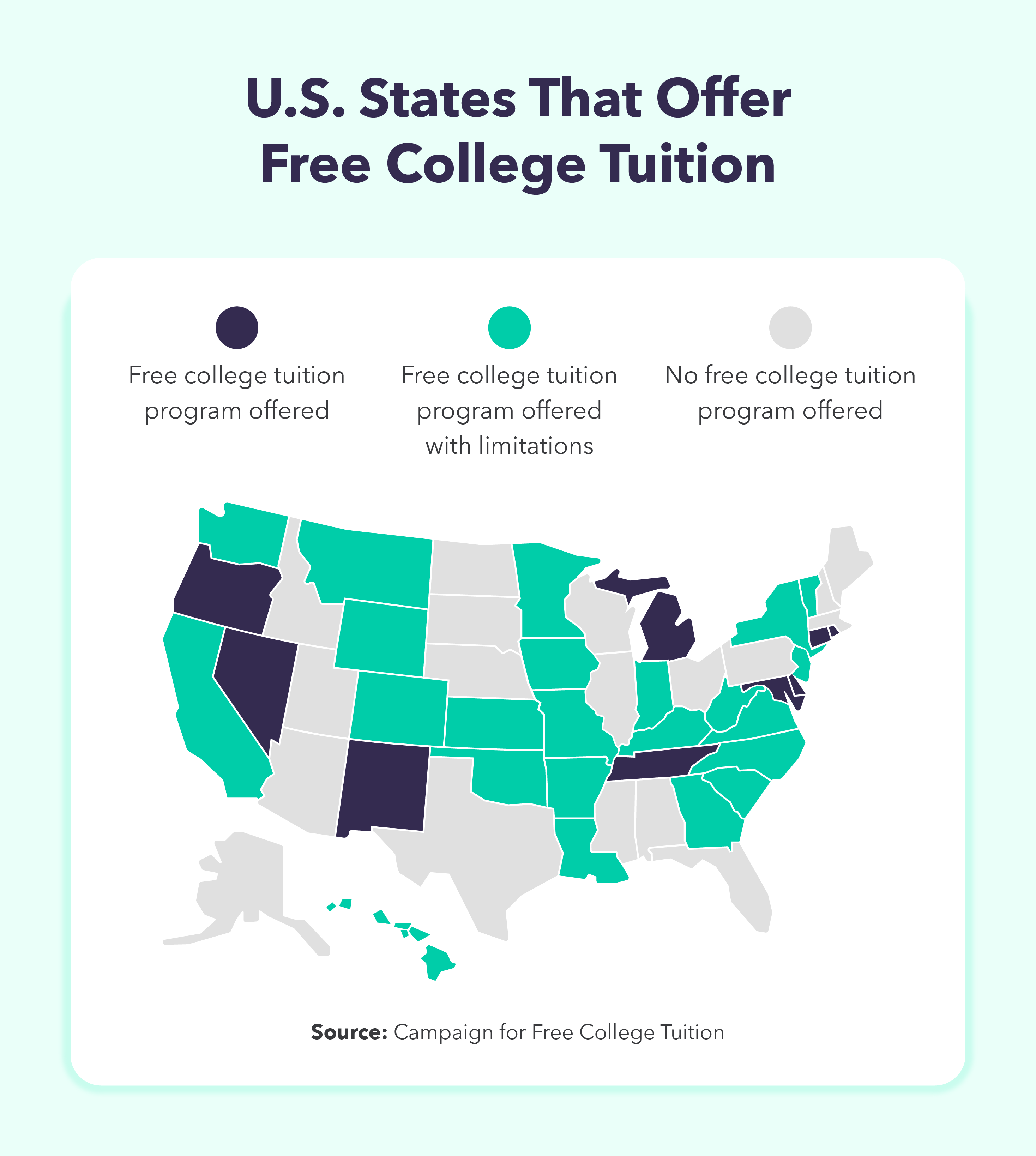
Based on the , there are 32 states in the U.S. with free college tuition programs in place.
- Arkansas —
- California —
- Colorado —
- Connecticut —
- Delaware —
- Hawaii —
- Indiana —
- Iowa —
- Kansas —
- Kentucky —
- Louisiana —
- Maryland —
- Massachusetts —
- Michigan —
- Minnesota —
- Missouri —
- Montana —
- Nevada —
- New Jersey —
- New Mexico —
- New York —
- North Carolina —
- Oklahoma —
- Oregon —
- Rhode Island —
- South Carolina —
- Tennessee —
- Vermont —
- Virginia —
- Washington —
- West Virginia —
- Wyoming —
How much you could get paid: With the average community college tuition and fees costing $3,800, these states sponsor students by awarding grant and scholarship money to cover their total tuition costs.
6. Check if You Qualify for Tax Breaks
Tax credits help you afford the by reducing the amount of income tax you have to pay on your tax return. You might even get a refund after filing your taxes if your tax credits exceed the amount you owe in taxes. The , worth up to $2,500, and the , worth up to $2,000, are both federal education tax breaks qualifying students can take.
You may also qualify for deductions following graduation, reducing the amount of your income that is subject to tax, and ultimately lowering the amount you owe in taxes. Even if you don’t itemize your deductions, you can claim the of up to $2,500 as an adjustment to income if you qualify.
How much you could get paid: You can receive up to $2,500 in tax credits just for attending college if you qualify.
7. Become an RA
If your college has on-campus housing, becoming a resident advisor (RA) is a great way to get paid to go to college. RAs enforce housing policies for students living on campus and push residents to succeed.
Most colleges provide RAs with free housing, meal plans, or stipends to go towards tuition and fees — total compensation averaging almost . Check out this that explains some of the pros and cons of being an RA.
How much you could get paid: On average, RAs get benefits, stipends, and incentives that total around $35,000 a year.
8. Join the Military

Serving your country by joining the U.S. Military is a rewarding opportunity that can pay off in more ways than one. Members, veterans, and their families may be eligible for .
- Military Tuition Assistance: This program can potentially fund the total cost of your college tuition and fees, paying up to $4,500 per year for eligible applicants and their spouses. Each branch of the military has its own requirements and application process.
- GI Bill: Implentend in 1944, the GI Bill helps qualifying veterans and their families pay for college, graduate school, or training programs. Under the Post-9/11 GI Bill, all tuition and fees for in-state students at public colleges or universities are fully covered, and it pays for up to $26,381.37 of private college tuition during the 2022 academic year. The U.S. Department of Veteran Affairs updates the every year.
How much you could get paid: Eligible members of the military receive $4,500 per year for school or professional training and could receive free college tuition at public in-state colleges.
9. Get a Work-Study Job
Applying for a is a great way to help cover costs with part-time employment while you’re enrolled in school. The Federal Work-Study Program provides these programs through your school’s financial aid office. You can earn money to help pay for education expenses while serving the community or working for your college in your field of study. Some common work-study jobs include:
- Library attendant
- Tutoring assistant
- Researcher
- Tour guide
- Fitness center assistant
- Computer lab tech
- Local food bank helper
- Animal shelter assistant
How much you could get paid: At the minimum, you’ll receive the for the hours you work or even more depending on the skills required for your work-study job.
10. Seek Off-Campus Employment
Another great way to cover the costs of a college education is to apply for a local or start a while you’re in school. Picking a job in the industry you want to work in when you graduate is also a great way to gain experience, learn more about what you’re majoring in, and network with other professionals.
According to the , on average, 74 percent of part-time students and 40 percent of full-time students have jobs. It’s important to remember to prioritize your education while working and avoid burnout to succeed both during college and after.
How much you could get paid: On average, off-campus jobs will pay college students a minimum of $10–$17 an hour based on experience and the industry. So, you can expect to make $3,600 a semester if you’re working 20 hours a week at $12 an hour.
11. Serve in the AmeriCorps
AmeriCorps is a network of over 1 million members and volunteers that work together to serve their communities. It’s a federal agency that anyone looking to create lasting change and make an impact can join. The AmeriCorps offers many benefits including a living allowance, loan deferment and interest forbearance, access to an alumni network, professional development opportunities, and money to go towards college or trade schools.
After serving in the AmeriCorps for about a year and enrolling in the National Service Trust, you will qualify for the , which you can use to pay your current tuition and fees for higher education or repay your existing student loans. Throughout the years, AmeriCorps members earned over 4 billion dollars in education awards to pay for college.
How much you could get paid: The Segal AmeriCorps Education Award is equal to the maximum amount awarded each year for the Pell Grant, which was $6,895 for the 2022–2023 school year.
12. Ask if Your Employer Has Tuition Reimbursement

If you already joined the workforce but are considering going back to school, ask your employer if they offer . Some companies partner with local colleges or universities to offer their employees compensation packages that include tuition assistance programs.
Each company policy will be different with set amounts or percentages they agree to pay, and requirements you must meet to remain eligible. Some employers will only pay for higher education that is relevant to your current line of work to benefit the company and reduce turnover. Remember that you still need to pay for your tuition costs up-front, even if your employer reimburses you.
How much you could get paid: Your employer will give you a set amount or percentage of your college tuition and fees that they are willing to pay.
Make a Plan to Attend College
There are ways you can get paid to go to school and possibly graduate with , you just have to be willing to look for them. You shouldn’t write off college just because you think you can’t afford it. So, how can you avoid joining the many students who graduate with and get paid to go to college?
Start making a plan ahead of time and to track all of your college expenses. If you do end up having to take out loans, don’t worry. We can help you find the that’s right for you.
Sourcing:
- Percentage of student loan debt. (September 2022)
- The number of students facing outstanding student loan debt. (September 2022)
- Free Application for Federal Student Aid. (September 2022)
- How to apply for the Pell Grant. (September 2022)
- Costs of community college. (March 2022)
- U.S. states with free college tuition options. (2022)
- Tax credits available. (December 2021)
- Education tax breaks. (December 2021)
- Tax deductions for loans. (August 2022)
- Total compensation of an RA. (May 2021)
- Video about the pros and cons of being an RA. (October 2020)
- Military education benefits. (April 2022)
- Military education payment rates. (September 2022)
- How to apply for a work-study. (September 2022)
- Current federal minimum wage. (September 2022)
- Percentage of college students with jobs. (May 2022)
- AmeriCorps pays for college tuition and fees. (September 2022)
The post appeared first on .